
How Much Is Our Civilization Worth?
SpaceX: Catastrophe Insurance for Consciousness

When I was a kid, I wanted to be an astronaut. I read every Stephen Hawking book I could get my hands on. I was the annoying child in the family who tried, and failed, to explain relativity to my uncles. I memorized useless facts no one had asked for, like the fact that sunlight takes eight minutes to reach Earth, or that Proxima Centauri, our nearest stellar neighbor, sits 4.2 light-years away.
I watched every documentary about the universe I could find and bombarded my parents with impossible questions long before the internet could answer them. How much energy does the Sun generate? If the universe is not infinite, where are the walls? Did time have a beginning? Will it have an end? One question led to another, and curiosity became an infinite staircase.
Then adulthood happened. Like most people, my gaze slowly moved downward. Toward work, responsibilities, capital, the immediate. Which is why one line from Interstellar has always haunted me: “We used to look up at the sky and wonder at our place in the stars.”
This week, SpaceX reminded me why we once did. You can debate Elon Musk endlessly. His politics. His temperament. We can debate for hours the valuation of SpaceX. But if an IPO filing contains words like “to build the systems and technologies necessary to make life multiplanetary, to understand the true nature of the universe, and to extend the light of consciousness to the stars,” it becomes difficult not to feel something. This is not the language of a normal company. It reads less like a registration statement and more like a manifesto.
And strangely, part of this story begins in Mexico. Before SpaceX, there was Intelsat. Before Elon Musk understood that controlling orbital infrastructure meant controlling connectivity, a Mexican media titan had already grasped a similar truth.
Emilio Azcárraga Milmo, known in Mexico simply as El Tigre, was one of the earliest believers in satellite communications and among the first investors connected to the Intelsat ecosystem. He transformed Televisa from a Mexican broadcaster into the largest media empire in Latin America because he understood decades ago what Silicon Valley is rediscovering today: the most powerful businesses are rarely content companies. They are infrastructure companies. Content captures attention. Infrastructure controls the pipes through which civilization experiences reality.
That ambition helped transform the 1970 World Cup in Mexico into something unprecedented: the first FIFA World Cup broadcast live in color across the planet via satellite. For the first time, football was no longer a local event. It became synchronized global emotion. In many ways, that was the moment media escaped geography.
More than half a century later, humanity has more than 12,000 satellites orbiting Earth. More than 10,000 of them belong to Starlink. SpaceX’s ambition is not simply to participate in this infrastructure layer. It is to dominate it.
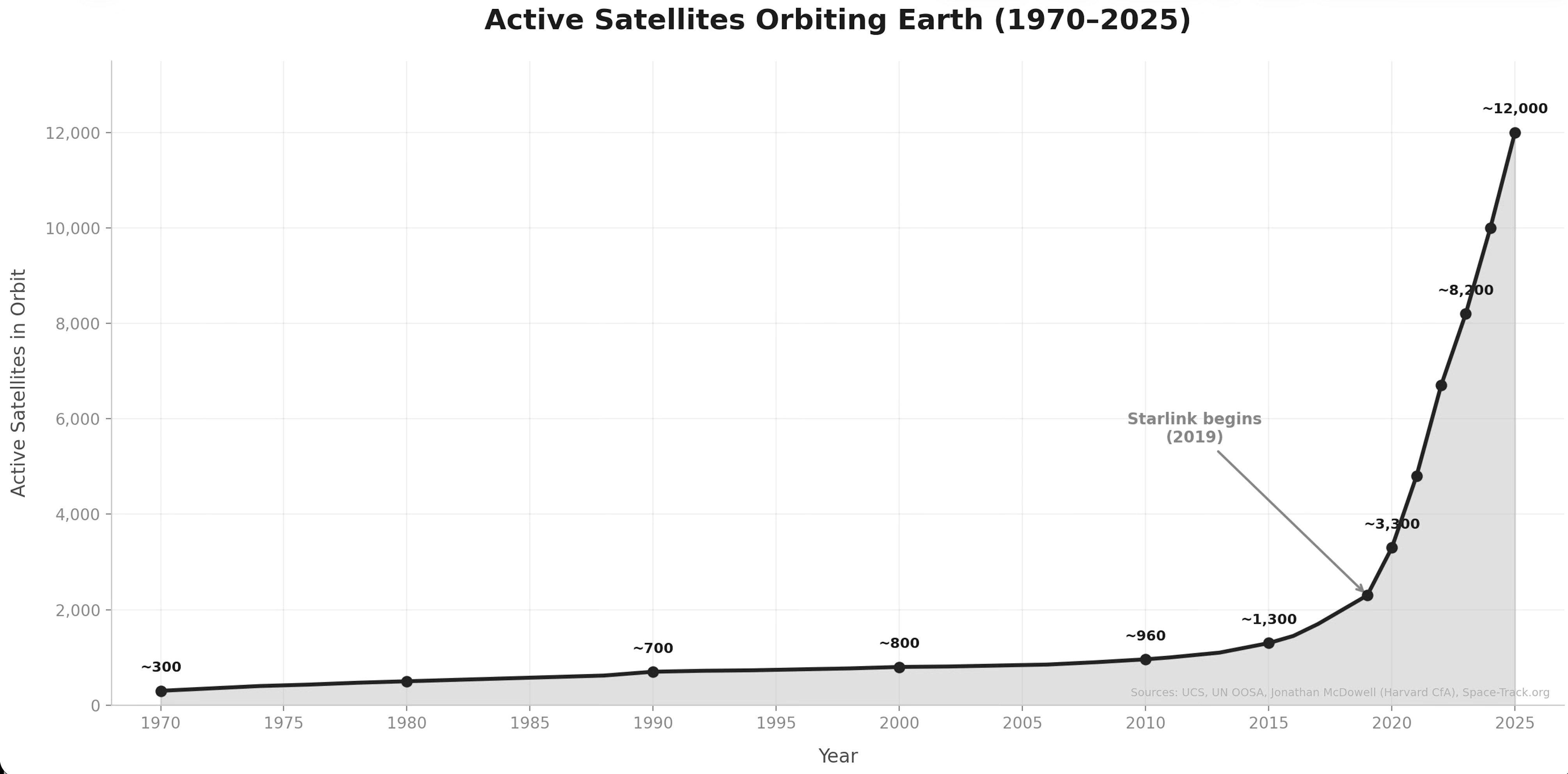
And then comes the truly extraordinary part. If you read between the lines of SpaceX’s ambition, its total addressable market is not launch services, satellite internet, or defense contracts. The implied answer is much larger. The GDP of the universe.
Which brings me back to the questions I asked as a child. Who owns the Moon? If you arrive first on Mars, can you claim it? How much is Earth worth?
Legally, no one owns the Moon. The 1967 Outer Space Treaty explicitly prohibits nations from claiming sovereignty over celestial bodies. But if you go deep, things get murkier. That treaty was written for nation-states, during the Cold War, not for private corporations building autonomous off-world civilizations.
if a Martian colony ever becomes self-sustaining, who governs it? Earth law? American law? Corporate law? A new Martian constitution? This is the point where science fiction begins mutating into legal reality. Because eventually, someone will ask a question that sounds absurd, until it doesn’t: If Earth governments did not build this civilization, why should Earth govern it?
And that is where SpaceX’s valuation starts to look less insane. This is where the road of infinite curiosity gets interesting. How do you value Mars?
By land value? Probably close to zero. Real estate is ultimately a function of proximity, accessibility, and utility, and Mars currently offers none of the three. By resource value? Perhaps trillions, eventually. Water, metals, industrial inputs, strategic minerals. But those valuations remain theoretical until Mars becomes economically productive. The framework I find most compelling is different.
What if Mars is not real estate? What if Mars is insurance? Not insurance for an individual. Insurance for a species. How much would humanity pay for a backup copy of itself? Which leads to an even more uncomfortable question: how much is civilization worth?
Global GDP today is roughly $110 trillion per year. If civilization were a mature public company and you valued it at a conservative 20x earnings or cash flow, you arrive at roughly $2 quadrillion.
But that may be the most unimaginative framework. Look instead at the asset base of civilization. Global equities represent roughly $120 trillion. Bonds another $140 trillion. Investable real estate more than $350 trillion. Add private businesses, infrastructure, commodities, logistics systems, data centers, ports, factories, intellectual property, and the balance sheet climbs toward $700 to $900 trillion.
Then there is human capital itself. More than 8 billion people. If the average lifetime economic contribution per human is somewhere between $500,000 and $2 million, the implied value ranges between $4 quadrillion and $16 quadrillion.
And even that may still underestimate the true optionality of civilization. So let’s simplify. Let’s assume civilization is worth just $2 quadrillion. Now imagine becoming multiplanetary reduces humanity’s extinction risk by only 1%.
One percent. That tiny reduction in extinction risk creates $20 trillion in expected value. Suddenly SpaceX stops looking like an expensive aerospace company. It starts looking like catastrophe insurance for consciousness itself.
And maybe that is the strangest part of all. You can debate Elon Musk endlessly. His politics. His temperament. His governance. The valuation. But what feels harder to debate is what this awakens inside us. Because underneath the spreadsheets, the satellites, the orbital economics, the absurd ambition there is something much older: Curiosity.
The irrational human instinct to look at impossible distances and still ask, what if? As children, many of us lived there naturally. Somewhere along the way, most of us traded infinite questions for finite responsibilities. And maybe that is why this story resonates. Not because SpaceX will necessarily colonize Mars. Not because the valuation will be right. But because, for a brief moment, it reminds us what it feels like to look up again. To reconnect with that version of ourselves that believed impossible things were worth chasing. To become, even briefly, a curious child again.
SpaceX has driven the cost of reaching low Earth orbit from roughly $16,000/kg down to under $1,200/kg on Falcon 9 (reused), and is now targeting sub-$200/kg on Starship. Very close to two orders of magnitude improvement.
Not to belittle Elon, he is an entrepreneur par excellence.. but also a con man.
Inhabiting Mars is a fantasy, simple physics preclude return travel… you go, you stay.
As for interplanetary.. we can’t even approach a tiny fraction of light speed so time is in thousands of years.